Children Around The World – 2004

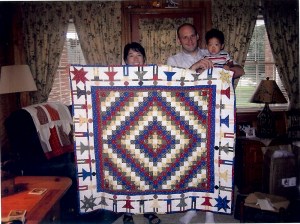
A new great nephew was on the way.  My family was quite busy during this period of time!  I found a pattern for children that looked like paper doll cutouts holding hands in a row and knew I wanted to do something with that.

For the quilt center, I pieced a trip around the world design.  I pieced the children holding hands for the outside border using the colors from the center design.  In the corners, I pieced stars using the same fabrics.

In the interest of time, I intended to machine quilt this but, for whatever reason, I wasn’t satisfied with the result.  I pulled out all the machine stitching (I hadn’t gotten too far) and hand quilted the quilt.  It is quilted in the ditch around the design in the center, along the borders, and around the children in the outer border.

Here is a picture of my great nephew and his parents with his new quilt.
The Flower Girl – 2003

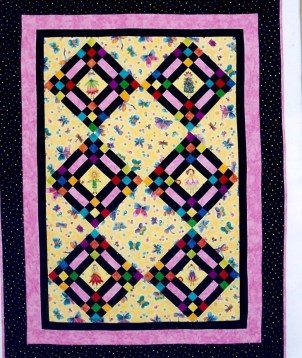
Another great niece was on the way.  I found a wonderful fabric of little girls dressed like flowers and decided to fussy cut them from the fabric and frame the cuts with nine patches and extended lines.  These were placed on point and then backed with a complementary yellow fabric with butterflies.

I used the bright colors from the butterfly and flower girl fabrics in the nine patches.  The quilt has triple borders, black with bright dots and the same  pink that was used to frame the blocks.

Quilting is done in the ditch around all the pieces in the blocks and around each border, with a decorative design in the background.

I Love You This Much – 2003

A new great niece was on the way!  I poured through my baby quilt books and fell in love with the patterns a book called “P.S. I Love You Two” by Nancy J. Smith and Lynda S. Milligan.  I thought this quilt was particularly

adorable and, even though it was a lot of hand work and I wasn’t sure if I would get it done in time, I decided to tackle it.  The background is a mottled pink.  I pulled a lot of colors from my stash (and from the quilt shop) and pieced the single Irish chain in the center.  The fabrics from the Irish chain were then used for the the appliqued Teddy Bear, hearts and letters.

This quilt is hand appliqued and hand quilted.  I quilted a line through the chains and extended this line into the borders but not through the appliques.  I quilted a heart in each pink square in the center of the quilt and quilted around the appliques and letters to emphasize them.

This is the pattern book.

Postage Stamp Baskets – 2003

This wall hanging got its inspiration from a packet of 5″ squares I received from a new line of fabric.  The colors were all so nice that I wanted to use them together.  I decided on a postage stamp baskets wall hanging.  I pulled out the strongest colors and used them for the baskets and handles,

surrounded the basket blocks with the lightest colors putting the blocks on point, then surrounded those blocks with the medium prints.  I was able to get two basket handles out of a 5″ square.  The entire center of the quilt was pieced from the 5″ squares plus the flowers in the corners.  I used other fabric for the borders and binding.

I used fusible interfacing to applique the flowers in the corners.  The flowers and interfacing are sewn together, right sides facing, using a quarter inch seam.  The seams are trimmed a little bit, a slit is made in the back of the interfacing and the flowers are turned right side out, pressed and appliqued down.  The nice thing about this method is the flowers are held in place when you press them down because of the fusible interfacing on the back, making it easier to applique whether by hand or machine.  The down side, in my opinion, is I didn’t feel that the flower edges were rounded enough.  Maybe I need to practice this method more.

The wall hanging is machine quilted.

Christmas Tree In The Window – 2003

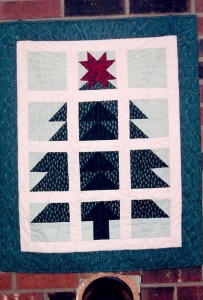
I found the pattern for this Christmas wall hanging in a book called “Small Quilts – The Vanessa-Ann Collection” from Oxmoor House.  It was easy to piece and I liked the simple effect.

I decided to hand quilt this in gold metallic thread in a design that radiated out from the star.  It’s a great look but I don’t recommend hand quilting with metallic thread.

Purple Scrappy Cats – 2002

I love cats and wanted to make a cat quilt.  I had seen some quilts of cats in a row back to back and face to face but couldn’t find a pattern.  Finally, I found one in a quilt magazine . I had a pretty purple floral fabric that I was itching to use, so I decided to pull the colors from that for my cats.

And that’s how Purple Scrappy Cats came to be.  It was fun to piece but a little tricky.  This quilt is machine quilted.  The tails and nose and mouth are quilted on the cats which also helps to hold the layers together.  I quilted a meander in the background and a larger meander in the border.  I had plenty of fabric left over so decided to use it for the backing.

After doing the quilting, I realized that print fabrics hide a multitude of machine quilting “sins”.  I could see everything I did wrong on the solid fabric but they disappeared in the print fabric.


Elton Johnfish and Mick Jaggerfish – 2002 and 2003

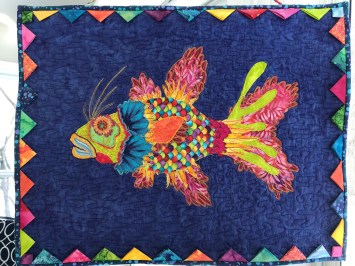
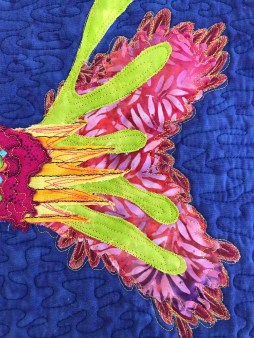
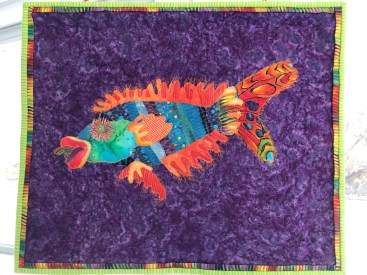
I took a fun class that involved laying pieces of fabric in a collage on a shape drawn on fabric.  In the class, we were offered different fish shapes, but whatever the fish started out to be, they sure became something different.

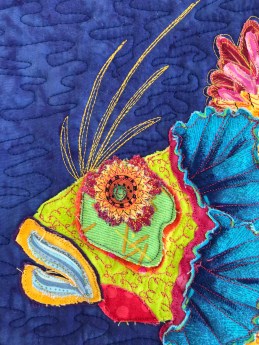
The idea was to take pieces of fabric, preferably unusual prints, cut them up and use them for the different fish parts.  The nuttier the look, the more fun the process became.  You start to look at your fabric in a different way – this looks like gills and this would be a great fish tail.  If I didn’t have the right eyes or lips, I just cut them out of fabric, layered that on more fabric until I created an interesting effect.


The pieces were fused down using a fusible web that can be repositioned.  Tull was used either over the entire fish or just certain parts, however you wanted.  This process was very freeing.  I named the first fish Elton Johnfish because it looks like he’s wearing wild glasses.

I had so much fun with the first fish that I did another.  I named this one Mick Jaggerfish.

After the fish were completed, I positioned them on a background fabric.  Some thread enhancement was done at this point.  Then batting and backing were added and more machine quilting was done, to further enhance the fish and to quilt the background.


I added bright fun borders – inverted prairie points to Elton and a flange to Mick, before binding.  This process can be used for almost any picture – birds, butterflies, landscapes, etc. as long as the original design doesn’t get lost.

Island Wedding – 2000

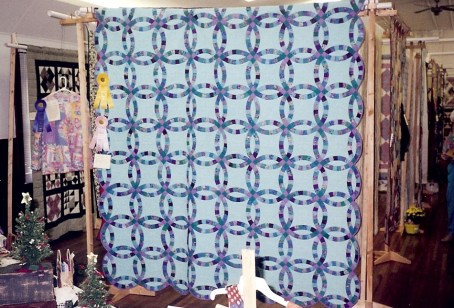
One (of the many) times I was fabric shopping, I came across the aqua background fabric I used in this quilt.  It was on sale so I bought a lot.  I then got the bright idea of making a double wedding ring quilt using this fabric so that led to fabric shopping for a lot of fabrics for the rings that went with the aqua.  It’s always so much easier and fun shopping for fabric than actually making the quilt!

A double wedding ring is not the easiest quilt to make and there’s a real trick to getting the rings to match where they join.  I was once at a quilt lecture where the audience was asked how many of us had made a double wedding ring quilt and a lot of us raised our hands.  Then we were asked how many of us had made two double wedding ring quilts and no one raised their hand.

That sounds like I didn’t enjoy making this quilt but I did.  I loved the variety of fabrics and enjoyed the challenge of putting the quilt top together.  It’s machine pieced and hand quilted.  I quilted a heart feather motif in the center of the rings and then quilted a smaller version of the four hearts in the areas where the rings overlap.  It’s quilted in the ditch around the rings.

Island Wedding won a Third Place ribbon and Best Hand Quilting at the 2000 Mooresville Centerpiece Quilters Show.   Here I am with Island Wedding at the show.


A Victorian Garden – 2002

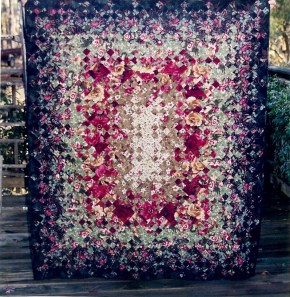
This pattern is from a book called “Tradition With A Twist” by Blanche Young and Darlene Young Stone.  All the patterns in this book are great but I particularly liked the Blooming Ninepatch.  It’s not difficult to make from a

technical standpoint, but a lot of attention needs to be given to fabric selection and placement as you sew.  You need a place to lay the blocks out, a floor or bed that isn’t going to be disturbed, or a design wall.

The design starts with 3 squares of the same fabric lined up on point in the middle.  These squares are surrounded by nine patch squares made up of the first fabric (the squares in the middle) and a second fabric.   The nine patch squares are surrounded by fabric squares of the second fabric.  The next surround is nine patches made up of the second fabric and a third fabric.  These are surrounded by squares of the third fabric and it goes on from there.  The blocks are sewn together on the diagonal which is why a design layout is so important.

I think prints work best in this quilt for the blending effect.  There needs to be a color relationship between each surround of fabric but contrast as you go outward gives a nice effect.  Finding enough different fabrics that work together is the challenge for this quilt.

Roses For Kobi – 2002

When I learned I had a granddaughter on the way, I knew I had to find the most precious girly girl quilt pattern.

I found it in a Barbara Brandenburg book called “Fancy Things.”


Of course, my quilt had to be pink.  I found rose and rose bud fabrics and all the right pink and green colors and started hand appliqueing.  The gingham border is all pieced using four different pinks.

The quilt is entirely hand quilted.  I quilted around the appliques, did a grid in the center background, quilted in the ditch in the gingham inner border  and diagonally on the outer border.

I decided I wanted to do something special for the quilt label, so in addition to the usual information, I cut some of the roses from the border fabric and appliqued them around the label in the broderie perse method.

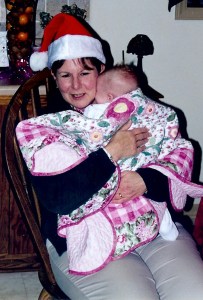
Here’s a picture of me with Kobi when I gave her the quilt (a few months late but finished).