Summer Window – 1988

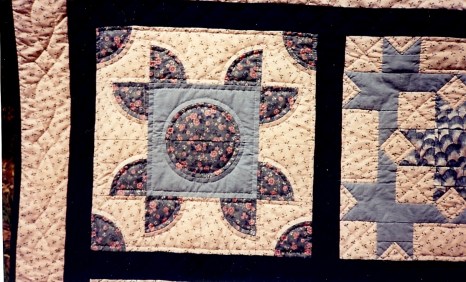
I took a class on stained glass quilting.  I picked a sunflower pattern to do as a wall hanging.  We didn’t use any short cuts in this class – instead we made our own bias binding and hand appliqued it around the pattern shapes to get the stained glass effect.  We were taught we could machine stitch some of the straight lines by opening up the bias tape and stitching it down in the crease on one side, the folding it over and appliqeuing the other side down by hand.

I hand quilted this wall hanging close to the appliques and also did a quilted design in the border which is difficult to tell since it’s on printed fabric.

I gave this as a gift to my mother and here she is holding it.

 

Trip Around The World – 1988

I took a class that demonstrated an easy way to do strip sets, cut them and line them up in a Trip Around The World design.  I really had to pay attention to get everything lined up right and was thrilled when I actually saw the design develop.

This lap quilt was machine pieced and hand quilted.  I quilted a straight line through the middle of each square using masking tape as a guide.

Sampler I – 1987

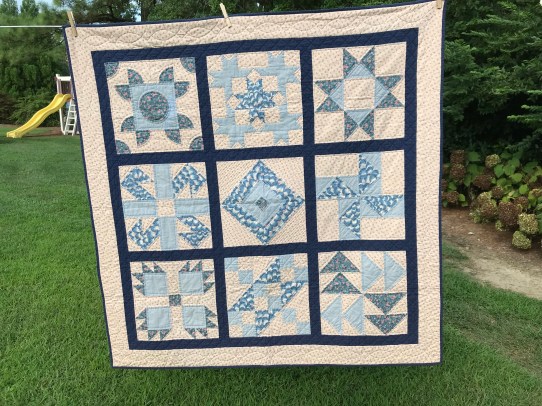
I feel as if this is my first real quilt – meaning I made it entirely the “right way” after I learned what I was doing as a quilter.  This is a sampler quilt I made during a beginners quilting class.

This quilt is hand and machined, mostly machine, pieced and hand quilted.  The blocks are:  Around The World, Dove At My Window, Ohio Star, Jack-In-The Box, my own design, Louisiana, Bear’s Claw, Jacob’s Ladder and Flying Dutchman.  I used a book called “The It’s OK If You Sit on My Quilt Book” by Mary Ellen Hopkins.  This is a great resource book for traditional blocks and I put a lot of wear on my copy thumbing through it.

I quilted 1/4 inch, using 1/4″ masking tape, around the block details, then did a simple X pattern in the navy sashing, and a simple design in the outer border.  I used cream thread in the blocks and border and navy thread in the sashing.

I had joined the Forsyth Piecers & Quilters Guild in Winston-Salem during this time and won a ribbon for this quilt at their 1987 quilt show for Best New Quilter.  Here I am with my quilt and the ribbon.


Christmas Wall Hanging – 1986

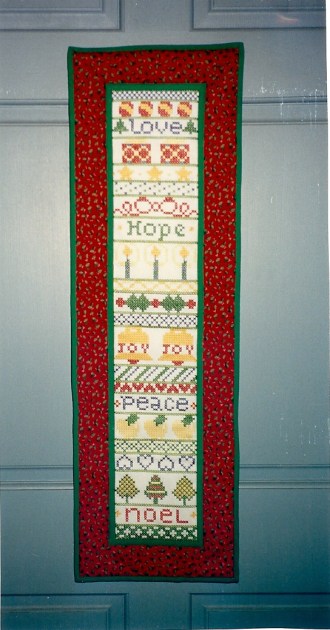
I had been an avid cross stitcher before I started quilting and had a lot of finished and unfinished cross stitch pieces (still do).  What do I do with them?!

How about finishing them in a quilted something.  The center of this wall hanging is cross stitched.  I finished it as a quilted wall hanging, quilting in the ditch around each border and then binding it.  I bring this out each Christmas and hang it on my door.

Amish Diamond – 1986

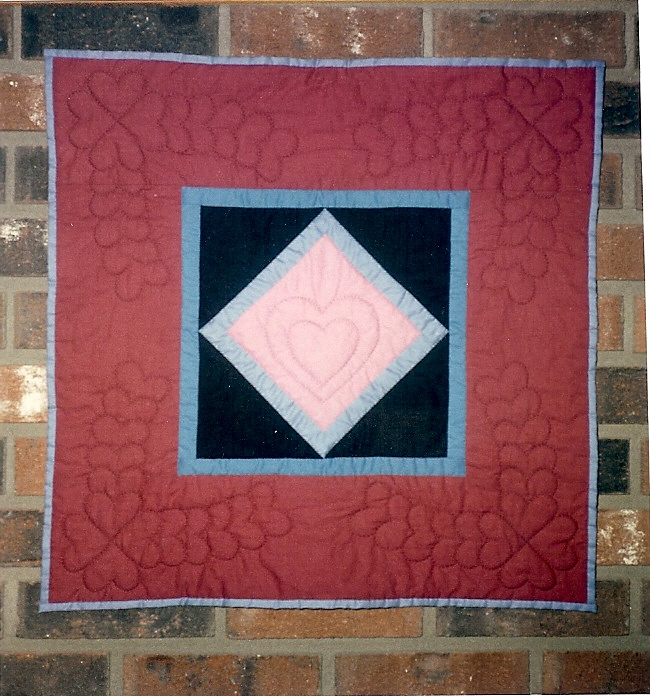
I admired, and still do, Amish style quilts and had bought several books on Amish quilting. This wall hanging is hand pieced and hand quilted.  I quilted a double heart in the pink center, a heart swag in the border and quilted in the ditch around the inner borders.

Looking back at this, I’m surprised that I jumped into marking and quilting the heart swag so soon in my quilting career.  I quilted the swag in black thread as is often traditional in Amish quilts (or so I read).

I Took A Quilt Class – 1986

Only another quilter can imagine how thrilled I was to find a quilt teacher.  The wife of a guy I worked with taught quilting in their home.  I signed up!  I took every class she offered.  I was amazed at the “little things” I learned from her and the other students that made such a difference in my quilting.  I’ve taken many classes since and can’t recommend them enough.


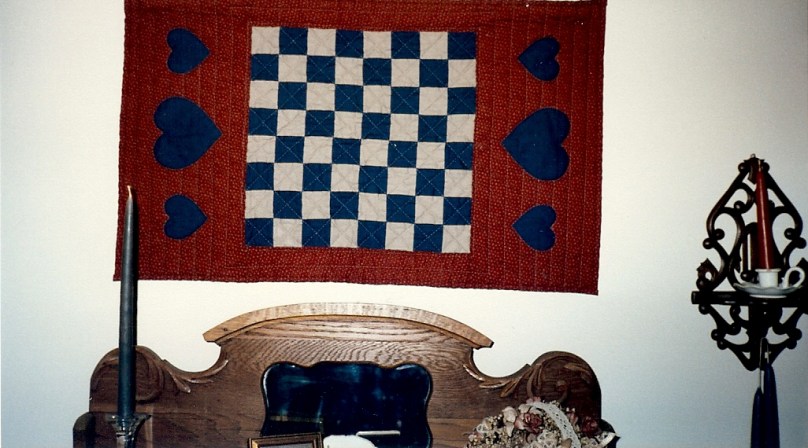
Checkerboard with hearts wall hanging or table topper.    It’s hand pieced, hand appliqued and hand quilted.

Yes, I was still hand piecing and was learning a lot in the process.  I would get to machine piecing but there’s a lot to say about learning from scratch.  The teacher was a stickler for the rules of quilting and that was fine.  I learned them all and later learned which ones I could break.  Things like straight of grain, on the bias, accurate quarter inch seams and why they’re important, needle turn applique at this early stage, marking a quilt top before you start quilting, thread basting, etc.  I don’t regret for a minute learning how to quilt from the basics.  Making a quilt is a slow process and learning to quilt is an even slower process.

Learning to Quilt – 1986

I had made two quilts but still didn’t feel as if I knew what I was doing.  I didn’t know any other quilters and there weren’t even any quilt shops in my area – fabric stores but not “quilt shops”.  Imagine that in North Carolina in 1986!  I think I just didn’t know where to look.  So I bought a “how to” book.  I don’t remember where I bought it, what the name of it was, and I don’t have it anymore – probably loaned it to another newbie.  I started at the beginning piecing, layering and quilting (still hand quilting).

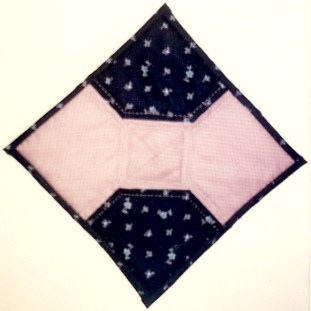
This is a pot holder made in the Bow Tie quilt block pattern.  It is hand pieced and hand quilted.


This is a hot pad made in the Nine Patch quilt block pattern.  It is hand pieced and hand quilted.


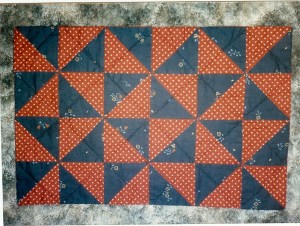
This is a table topper or wall hanging made in the Pinwheel quilt block pattern.  I’m getting a little braver making multiple blocks and sewing them together.  This is hand pieced and hand quilted.


This is a School House block which I made into a pillow.  It is hand pieced and hand appliqued to the background, then hand quilted.


Pink and Green Log Cabin – March 1986

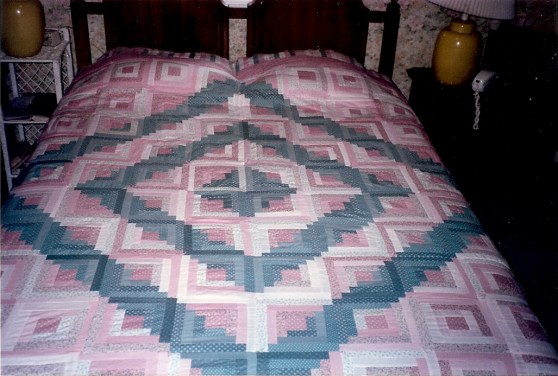
My second quilt was made in 1986.  I got the “quilting fever” and I’ve never looked back.  I love pink and green together and have used that combination in many subsequent quilts.


This is a log cabin pattern set in a barn raising layout.  It’s queen size, machine pieced and “tied”.  Tying a quilt is knotting yarn or floss or other comparable thread approximately every 4″ to hold the layers together.  I was burned out after quilting the basket quilt and was looking for a quick method to finish this quilt.

A lesson I learned on this quilt is “do not scrimp to save money by using poor quality fabric.”  I did that with this quilt and the seams frayed to the point where they compromised the seams.  Tying the quilt added to the problem because it did not hold the quilt together the way heavier quilting would do.  I learned as I went from mistakes I made.


Basket Quilt – 1985

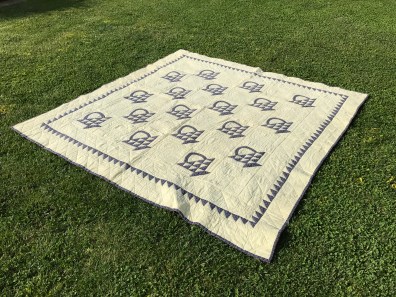
This basket quilt is my first attempt at quilting.  I had wanted a quilt for a long time, had no idea how to make one and, after looking into having one made, knew I couldn’t afford buy (they were very reasonably priced, just not in my budget at the time).


I started this quilt in 1982 when there were very few quilters and I had no idea what I was doing.  I bought some fabric and a book and got started.  There’s a lot to be said about naivete’ because I probably wouldn’t have made this quilt if I had any idea how complicated and long the process would be.  It is a small queen size and made of all cotton fabrics.  I machine pieced and hand quilted it.  In 1985, machine quilting hadn’t really caught on.  The baskets are outline quilted with a duplicate basket shape quilted in the plain blocks.


The biggest mistake I made on this quilt (and there were many) was using high loft batting.  I didn’t know better!  Especially since I planned to hand quilt.  I couldn’t using the rocking method because of the thickness of the quilt sandwich, so I quilted it using the “punch/pull” method in a quilt hoop that had a floor stand.  “Punch/pull” quilting is sticking the needle in from the top and pushing it back up with your other hand from under the quilt.  It took forever!  It’s a wonder I finished it!  I started the quilt in 1982 when we lived in Petersburg, Illinois, and finished it after we moved to Troutman, North Carolina in 1985.